Robotics and Automation
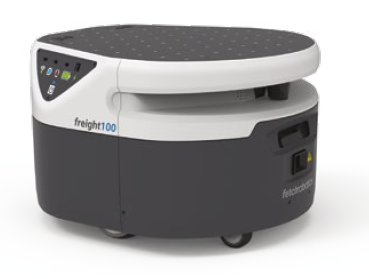
The Fetch Freight100 OEM Base and software are a powerful blank canvas that helps you reduce R&D costs and get to market faster. The AMRs are easily connected to any system or control interface and are intuitive for teams to operate and manage. The base supports any build approach, be it component integration, private label, or a custom product development.
- Assured safety – some of the most advanced safety features available enable obstacle avoidance and detection. And two 3D cameras give superior vision to avoid ground-based and overhanging obstacles. The Fetch Freight100 OEM Base carries the CE mark and FCC registration.
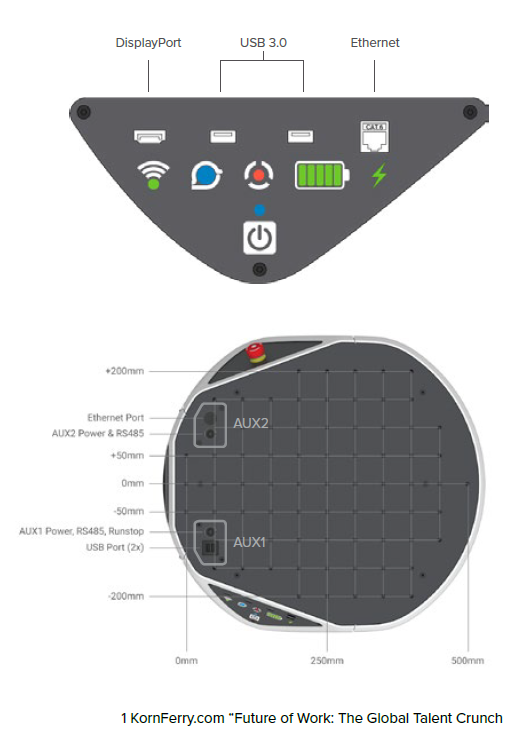
- Flexible mounting – a modular top-plate with 73 threaded mounts makes it easy to connect hardware and sensors.
- Versatile connectivity – two power ports, direct communication bus, Ethernet, and USB 3.0 ports on the top of the base make it easy to connect accessories. A side panel provides access to Ethernet, USB 3.0 and DisplayPorts.
- At-a-glance status – with Wi-Fi, battery, run-stop, and Fetch Core status lights.
- Simple integrations – REST APIs make it easy to connect your autonomous mobile robot with other applications such as industrial control systems. The base also comes with a full suite of FetchCore™ Enterprise software, which makes it easy for you to develop, setup, and deploy your AMR solutions.
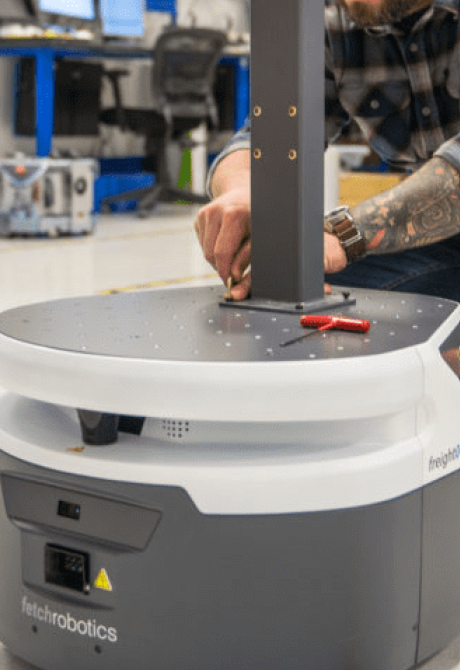
The Fetch Freight100 OEM Base enables a huge range of applications across sectors.
Some of the highlights include:
Agriculture
AMRs are used to transport items to workers in greenhouses, manage crop curation – such as watering and plant treatment with herbicides and pesticides – and photograph the status of crops to assess health. They can also check temperatures and humidity, and gently harvest crops in greenhouses to reduce plant damage.
Healthcare
AMRs deliver supplies, such as medications, lab samples, and medical equipment, across clinics, freeing up staff for more valuable tasks. Mobile solutions can also be used to disinfect areas, while devices with telepresence capabilities can enable remote healthcare providers to interact with patients and clinicians.
Hospitality
AMRs equipped with touchscreens can take orders and be used to transport items to tables and clear them away, with demand, too, for robots which can clean and disinfect floors and surfaces. In hotels, AMRs can check people in, show them to their room, deliver and collect room service, assist housekeeping with cleaning tasks, undertake security checks, and monitor air quality and temperature.
Retail
AMRs can be used to take items from the toreroom to customers in store, carry out stock checks, replenish items on shelves, answer basic customer queries and help them find items, manage cleaning, and monitor the store for potential theft or other security threats.